Cluster Feeding: What's Normal and What's Not?
It’s 7pm. Your baby has been on and off the breast for three hours. You haven’t eaten. Is something wrong? Probably not — but let’s go through it.
What cluster feeding actually is
Cluster feeding is a period of very frequent, bunched-together feeds — usually over two to four hours. It’s most common in the evenings, and it shows up a lot in the first six to eight weeks.
In my years as a lactation consultant, this is one of the most common reasons parents call in a panic. And almost every time, what they’re describing is completely normal infant behavior.
Why babies do it
A few things drive cluster feeding, and they often overlap.
Growth spurts. Around days 2–3, days 7–10, and again at weeks 3 and 6, babies ramp up feeding to match a growth need. It’s demand-driven — they need more, so they ask for more.
Supply regulation. Frequent feeding in the early weeks is how your body calibrates production. Removing milk frequently tells your body to make more. This is the system working as intended.
Comfort, not just hunger. Babies don’t separate the two the way we do. Suckling regulates their nervous system. Evening fussiness — sometimes called the witching hour — is real, and feeding is often the fastest way through it.
Cluster feeding is not evidence of low supply. In fact, it’s often what builds supply in the first place. The two things get confused a lot, and I’d rather you hear that clearly than second-guess yourself at 9pm.
How many feeds per day is normal?
This is a question I get constantly, and there’s actually a useful number to hold onto: 8 to 12 feeds in 24 hours is the range where most newborns grow well. That’s roughly every two to three hours, with some natural bunching in the evenings.
If your baby consistently needs more than 12 feeds a day — not just during a growth spurt, but day after day — that’s a flag worth paying attention to. It can mean feeds aren’t efficient, transfer is low, or something else is getting in the way of them feeling full. It’s not an emergency on its own, but it’s a reason to get eyes on the latch and check weight gain.
A growth spurt will push you past 12 for a few days. That’s different. What I’m looking for is a persistent pattern that doesn’t resolve.
Here’s how I’d break it down:
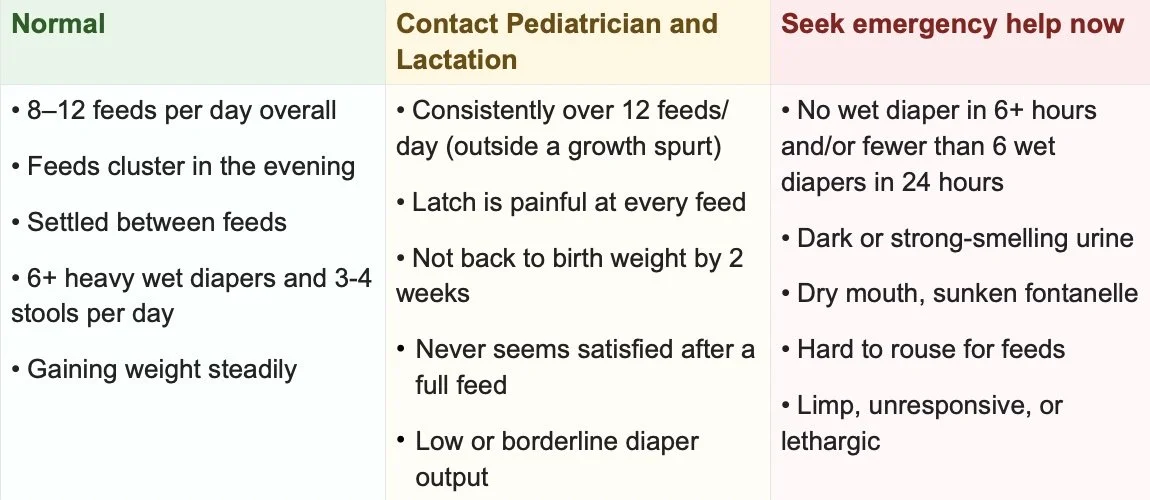
*This is general guidance, not medical advice. Please contact your healthcare provider if something does not feel right.
How long will this last?
A single cluster session: two to four hours, usually. A full episode — the intense, back-to-back feeding stretch that has you googling at midnight — typically lasts 2–3 days before it eases off. (*If cluster feedings last more than 2-3 days, it maybe worth reaching out your lactation consultant.)
It doesn't feel short when you're in it. But it is.
Getting through it
There’s no shortcut here. What helps is practical: ensure that you are getting enough calories, drink to thirst to stay hydrated, and if you have a partner or support person, this is the time to use them — not for feeding, but for everything else so you can just sit.
If you’re combination feeding or exclusively pumping, the same principles apply. Follow hunger cues. Don’t try to stretch feeds to create a schedule.
A Quick Note of Encouragement
The parents who struggle most with cluster feeding are often the ones who’ve been told their baby “should” be going longer between feeds by now. Feed the baby in front of you, not the one in the chart. If output is good and weight is tracking, you’re doing it right.
This post is for informational purposes only and does not replace advice from your healthcare provider, midwife, or lactation consultant. When in doubt, reach out to someone who can actually see your baby.